· LumenTrail team
How to Clean a Headlamp
A headlamp gets dirty in a way most gear does not, because it sits on the part of you that sweats first and it points at whatever you are working on. Mud, dust, sawdust, drizzle and hair product all end up on the same small piece of plastic. None of it needs a special product — but a lamp that is wiped now and then throws a cleaner beam and answers your hand faster than one that never is.
What actually gets dirty
It helps to stop thinking of the lamp as one object. There are five surfaces on a LumenTrail headlamp, they get dirty in different ways, and only one of them ever needs more than a wipe.
The lens cluster. The bright center beam sits between two side LEDs behind a clear cover. Everything that lands here scatters light before it leaves the lamp.
The sensor window. A small dark window above the LEDs holds the infrared emitter and receiver that read your wave. It has to see your palm to work.
The housing. The body and the tilting hinge, where grit collects in the seam and makes the tilt feel gritty instead of smooth.
The band. Elastic webbing and a slider buckle — the part that absorbs sweat and holds it.
The charging port. The USB-C socket, the only opening that genuinely rewards care.
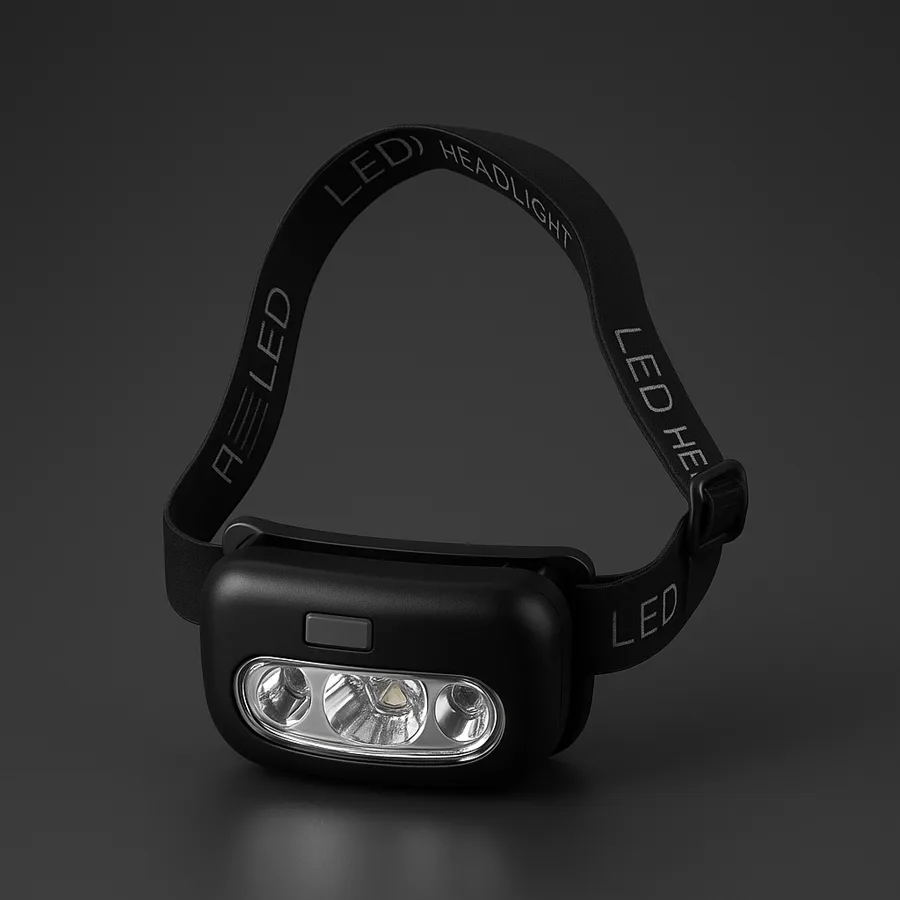
Sorted that way the job is quick: four of the five take one pass of a cloth, and the fifth just needs to be dry before a cable goes in.
The two-minute wipe-down after a wet or muddy night
The habit that matters most is the one you do the same evening, while the lamp is still in your hand and before anything has time to dry on. It takes about as long as unlacing your boots.
Take the lamp off and shake off any standing water. Wipe the whole outside with a soft damp cloth — housing, lens cover, sensor window, hinge seam. If there is mud on it, let the cloth do the work rather than your thumbnail, because dried grit dragged across a lens cover is what leaves fine scratches. Then dry it with the other end of the cloth, pay particular attention to the charging port, and leave it on a shelf rather than sealing it damp inside a pack.
That last point is the one people skip. The lamp carries an IPX4 rating, so rain, sweat and splashes are exactly what it is built for — but a damp lamp stuffed into a closed bag stays damp for days, and so does the band wrapped around it. Ten seconds of drying solves it entirely.
The lens: dust costs you more than you expect
A film of dust on the lens cover does not dim the lamp so much as blur it. Light that should leave in a clean column hits each particle and scatters sideways, which lifts a faint haze in front of your eyes and softens the edge of the beam. The effect is gradual enough that most people never notice it happening — they simply feel that the lamp is not quite what it was, when in fact the lens is doing the work of a diffuser it was never meant to be.
Fingerprints do the same thing, and they arrive often, because the lamp is small enough that people pick it up by the front. Grease spreads into a thin layer that is almost invisible on a dark lens and very obvious the moment you switch on in fog or drizzle, since it scatters exactly where the airborne droplets already do.
A soft cloth, barely damp, wiped in one direction across the cover clears both. Keep abrasive pads and solvents away from it — plain water lifts everything a headlamp realistically collects, and anything harsher risks hazing the plastic for good. A glasses cloth is the ideal tool and weighs nothing in the pack. How much that clean beam actually buys you is covered in how many lumens a headlamp needs.
The sensor window: the part people forget
The wave sensor is the feature buyers reach for most, and it is the one most affected by a dirty lamp — yet it is the surface nobody thinks to clean, because it is dark, small and easy to mistake for a decorative panel.
The sensor is an infrared emitter and receiver mounted next to the LEDs. It throws out invisible infrared light, and when your hand passes a few inches in front of the lamp that light bounces off your palm back to the receiver, which reads the bounce as a gesture. The mechanism depends on the window being clear in both directions: the light has to get out, and the reflection has to get back in.
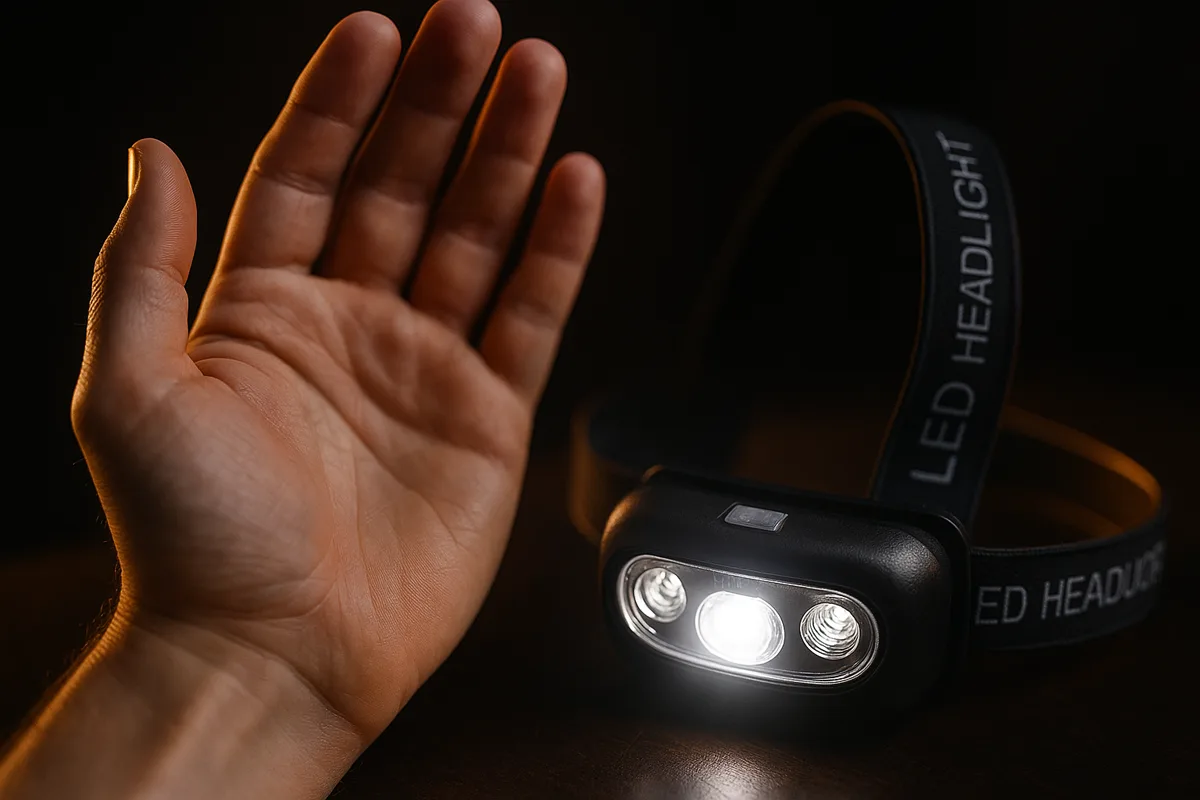
So a smear of sunscreen, a splash of dried mud or a thumbprint on that window sits directly in the light path. Wipe it whenever you wipe the lens — same cloth, same pass, no extra step — and the wave stays as crisp as it was on day one. How the gesture control behaves, and when to switch it off with the button instead, is on the motion-sensor headlamp page.
The headband: sweat, salt and grit
The band is where wear shows first on any headlamp, and it is the only part that ever wants more than a wipe. Elastic webbing absorbs sweat, sweat leaves salt behind as it dries, and salt crystals are abrasive — they work at the fibers from the inside every time the band stretches. Add trail dust and the band slowly turns stiff and scratchy, which is usually what people are describing when they say a lamp has become uncomfortable.
Hand-washing solves it and takes a minute. Slide the band out of its buckle to reach the folded sections, work it in lukewarm water with a little mild soap, squeeze rather than wring so the elastic keeps its shape, rinse until the water runs clear, and hang it to dry away from a radiator. Direct heat is what kills elastic: it dries fast and comes back tired, having lost the springiness that kept the lamp still on your forehead.
Do this a few times a season if you run or hike in it, less often if the lamp mostly lives in a drawer. A band that still grips is what stops the lamp nodding with every stride, so this upkeep protects the fit rather than the finish. Setting that fit in the first place — band position, rear tension, the tilt of the head — is covered in how to wear a headlamp.
The USB-C port: the one part worth being fussy about
Every other surface forgives you. The charging port is the one to be deliberate about, and the rule is simple: it should be dry and clear before a cable goes in, every time.
Water sitting in a socket while current flows through it is what corrodes contacts, and the port is the natural low point on a lamp that has been out in the rain, so a drop can sit there long after the outside feels dry. Tip the lamp so the opening faces down, blot it with the corner of a cloth, and give it a few minutes before charging. Lint is the other culprit: pocket fluff compacts into the bottom of a USB-C socket over months and eventually holds the plug far enough out that it seats loosely. A dry lamp and an occasional look inside prevent both.
Once the port is clean and dry the rest is easy: the indicator glows red while the built-in 3.7V battery charges and turns green when it is full, from any phone charger, laptop or power bank. Charging habits and battery care are a subject of their own, and we go through them in the charging guide.
Storing it so it is ready when you grab it
Most headlamps spend more hours in a drawer than on a head, and storage does more to determine their condition than any single outing. Three things are worth getting right.
Store it dry and store it open. A lamp that goes away clean and dry comes out the same. Leave the band loose rather than cinched tight around something, because elastic held stretched for months gives up some of its recoil.
Switch it fully off rather than leaving it on standby, and if it lives in a bag, turn the sensor off with the button before it goes in. That way a strap brushing past the window in transit cannot wake the lamp and run it down inside a closed pack.
Give it a home. The lamp you actually use is the one always in the same drawer, glovebox or pack lid, because in the dark you find it by memory rather than by looking — which is why most people end up with one in the car, one in the camp bag and one in the kitchen drawer.
A care rhythm through the dark season
Autumn and winter are when a headlamp earns its place and also when it takes the most abuse. The nights get long, so the lamp comes out daily instead of on weekends, and everything it meets is wet: rain, mud, leaves, road grit and the salt spread on pavements. A lamp used four nights a week in November collects more in a month than across a whole dry summer.

Road salt deserves a mention because it is the one contaminant people do not think of as dirt. It arrives as spray from passing cars, dries invisibly on the housing and the band, and stays there. A damp wipe removes it in seconds while it is fresh, which is why the wipe-down matters more from November onward than at any other time of year — it is the cheapest way to keep the lamp feeling new through the months you actually use it.
So the rhythm through the season is: a damp wipe of the lens, sensor window and housing after any wet or dirty outing; a dry port before every charge; and a band wash every few weeks if you sweat into it. If your dark-season use is mostly running, the companion routine for setup and visibility is in choosing the best headlamp for running, and the checks we put a lamp through are set out in how we test headlamps.
Headlamp care checklist
| Part | What it needs | How often |
|---|---|---|
| Lens cluster | Soft damp cloth, one direction, no abrasives or solvents | After any dusty or wet use |
| Sensor window | Same cloth, same pass — keep the infrared path clear | Same time as the lens |
| Housing & hinge | Wipe the seam so the tilt stays smooth | Whenever it looks dirty |
| Elastic band | Hand wash in lukewarm water, squeeze dry, air dry away from heat | A few times a season |
| USB-C port | Face down, blot, air-dry — clear of lint | Before every charge |
| Storage | Dry, switched off, sensor off, band left loose | Every time it goes away |
None of this needs a kit. A soft cloth, a little water and thirty seconds of attention keep a LumenTrail headlamp throwing a clean beam and answering your hand for years — and every order is backed by our 30-day money-back guarantee.