· LumenTrail team
Headlamp Etiquette at Night
A headlamp does something no handheld light does: it points wherever you look. That is the whole reason to wear one, and it is also the reason the beam ends up somewhere you never chose to send it. Turn your head to answer a question and you have aimed a light straight into someone's eyes without deciding to. Nobody does it on purpose. It happens because the light follows your attention, and your attention goes to the person talking.
None of this is a reason to run a dimmer lamp. It is a reason to know the three or four moments when the beam wants managing, and what to do in each. They take about a second each, and after a couple of nights you stop thinking about them.
In headlamp etiquette, what actually bothers people is direction, not lumens
It is tempting to blame brightness, because the moment feels bright. But a strong beam aimed at the ground just ahead of you bothers nobody, while a modest beam held level at chest height bothers everybody it reaches. The variable that changes the experience is where the light lands.
The same goes for the shape of the beam. A tight centre beam concentrates its output into a small circle, so when that circle crosses a face it crosses it hard. A wide, low flood spreads the same job over a much larger area at much lower intensity, which is why it is the setting for anything happening within arm's reach: cooking, reading, rummaging in a pack, talking. We go through which setting suits which task in the lumens guide.
Once you see it as a direction problem rather than a power problem, the fixes are obvious and none of them involve accepting less light when you actually need it.
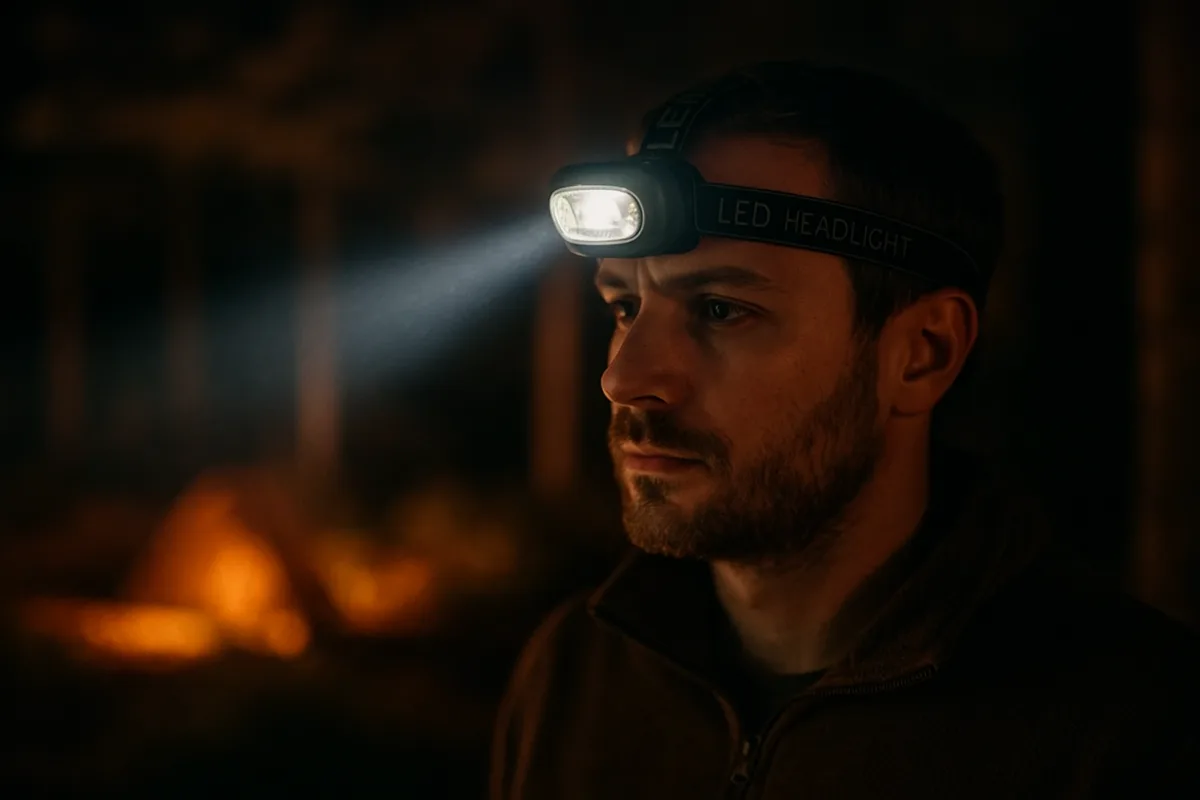
Arriving at a camp that is already dark
This is the classic one. You walk in at nine at night, everyone else has been sitting around a low fire for an hour, and you sweep a centre beam across the whole group looking for a flat patch of ground. Six people put their hands up at once.
The sequence that avoids it takes no longer than the sequence that causes it. Before you come round the last corner, tilt the lamp steeply down so the beam pools at your feet, and drop to the wide low setting. Walk in like that. Find your pitch by looking at the ground, which is where the information you need actually is — you are looking for level, for roots, for stones, all of it below knee height. Only lift the beam once you are away from the group and pointing into empty space.
If you need to check something at head height — a branch, a guy line, a sign — turn your body so you are facing away from people first, then look up. Turning your shoulders rather than just your eyes is the habit that makes the whole thing automatic, because the lamp is bolted to your head and follows the head, not the eyes.
The moment you turn to talk to someone
Standing and talking is where the beam does its most reliable damage, because conversation makes you face people. Two responses work, and which one you pick depends on how long you will be standing there.
For a quick exchange, tilt the lamp hard down before you turn. The beam lands between your feet and theirs, throws enough spill for both of you to see each other's faces, and points at nobody. This is the single most useful adjustment on a headlamp and the one most people never touch; the guide to wearing a headlamp covers how far the head pivots and how to set it for other tasks.
For anything longer than a sentence or two, switch the lamp off. If you are sitting round a fire, a stove or a table, there is already enough light to see faces, and the person opposite you will notice the difference immediately. Switching off is also the answer when someone is taking a photograph, when someone is reading a map that you are both looking at, and when a child is trying to go to sleep beside you.
The thing that makes people leave a lamp on when they should not is friction: finding the button in the dark with cold or full hands. A wave sensor removes that friction entirely — with sensor mode active, a hand passed a few inches in front of the lamp switches it off and back on, so turning the light off briefly costs you nothing and you actually do it.
Headlamp etiquette when you meet people on a path
On a shared path — a towpath, a park loop, a trail head, a campsite track — you and the person coming the other way each have a light pointing at the other. The convention that works is simple: as soon as you register someone approaching, tilt down. You lose nothing, because at that distance the useful information is still the ground in front of you, and they get their view of the path back.
Do not switch off completely while you are moving. Being seen matters, and a light that vanishes as someone approaches is worse for both of you than a light aimed low. On a bike path or a road, being visible to people is the entire point of carrying a light at all, which we cover in the running guide.
Cars deserve a separate note. If you are walking on or beside a road, keep the beam low and let the driver's own headlights do the work of showing you the surface. Aimed low it does its job and stays out of the driver's way, which is all the situation asks of it.
Walking as a group is the version of this that catches people out, because everybody's lamp is pointed at the back of the person in front. In single file, the person leading is the only one who needs reach; everyone behind is walking in light that is already there. Drop to the wide low setting once you fall into line and the whole group sees better, because nobody is looking into a beam over their own shoulder. Swap the lead round if the leading beam is doing the work, and the charge lasts across the group rather than draining one lamp — the criteria behind that judgement are set out in how we choose headlamps.
Sharing a tent, a van or a room
Inside a small space, everything reflects. A centre beam bounced off pale tent fabric fills the whole space with light and lands on everyone in it, whether or not you aimed at them. The wide low setting aimed steeply down at your own hands is the setting for every job you do inside: unpacking, changing, reading, sorting out a sleeping bag.
There is a second option that people forget, which is to stop wearing it. Take the lamp off, loop the band around a pole, a hook or the handle of a bottle, and turn it to face the fabric rather than the middle of the space. You get soft, even light that is not attached to anybody's head, and nobody gets a beam across the face every time you move. That trick, and the rest of what the format does well, is in headlamp vs flashlight.
If you are the one going to bed first, ask for the low setting rather than for lights out. It is a smaller request, people say yes to it, and it works.
When the whole point is to look at something dark
Some nights the reason you are outside is the dark itself: a clear sky at camp, water at night, the far side of a valley, a fire that everyone has settled in front of. In those moments a beam swept across the group does not just irritate people, it ends the thing they came for — everyone loses the view and has to sit and wait for it to come back.
The etiquette here is stricter and easier. Lamp off by default. When you do need it — to find a cup, to pour something, to walk to the tent — turn away from the group first, use the wide low setting, keep it aimed at your hands or your feet, and turn it off again before you turn back round. Announcing it helps more than you would think: one word before you switch on lets everyone look away.
The same applies when you are watching for animals near water or at the edge of a field. A beam swung around at head height announces you across the whole clearing. Aimed at the ground in front of your boots, it does not.
What the lamp gives you to work with
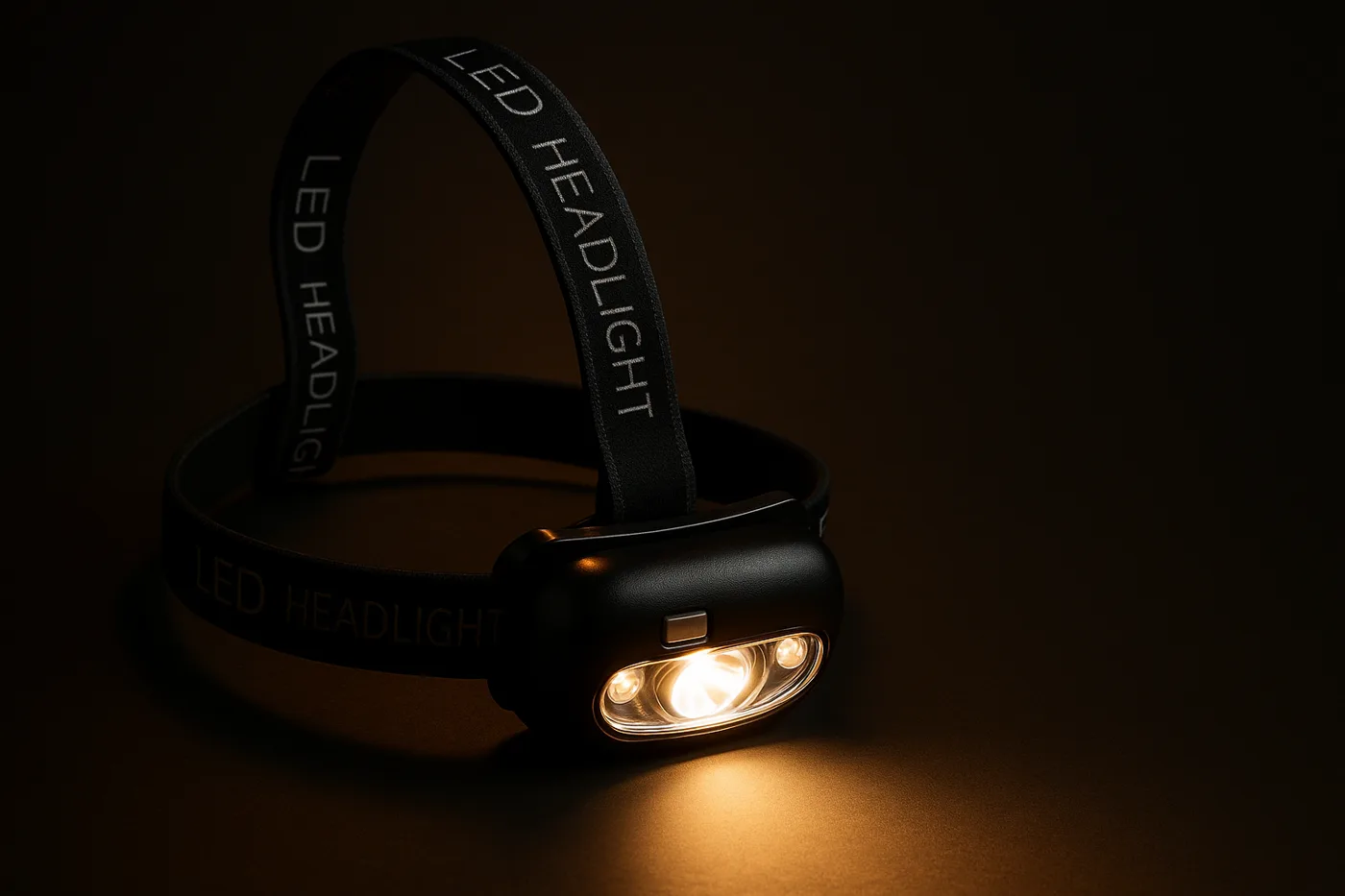
All of the above comes down to three controls, and the LumenTrail headlamp puts each of them under one finger.
The tilt. The head pivots down so the beam lands at your feet instead of at eye level. This is the control that does most of the work in this article: it changes where the light lands while leaving brightness and runtime exactly where they were.
The wide low setting. Two side LEDs spread a soft, even wash for everything close in front of you, alongside a bright centre beam for when you need to see down a trail. Running the wide low beam for camp jobs also stretches the charge: the lamp is rated at roughly four to six hours per charge depending on the mode, with the low flood lasting toward the top of that range. Charging habits are covered in the charging guide.
Off, without hunting for a button. The wave sensor means switching off in company is a gesture rather than a fumble, and the physical button gives you an ordinary predictable lamp whenever you want the sensor out of the way — near a fire, in a crowded tent, or during close work where your own hands would keep triggering it.
Put together, those three make a headlamp that is comfortable to be around as well as to wear, which is the difference between a light you carry and a light you actually switch on when other people are there. It is IPX4 rated for rain and sweat, it charges from the same USB-C cable as your phone, and every order is backed by our 30-day money-back guarantee.
Night headlamp etiquette FAQ
Should I turn my headlamp off when I talk to someone? For anything more than a passing word, yes. For a quick exchange, tilting the lamp steeply down does the same job and keeps enough spill for both of you to see each other.
What setting should I use around a campsite? The wide low flood, tilted down. It lights the ground and your hands, which is where campsite jobs happen, and it spreads its output instead of concentrating it into a circle that crosses faces.
How do I stop blinding people on a shared path? Tilt down as soon as you see someone coming, and keep the lamp on rather than switching it off — being visible still matters. Lift the beam again once they have passed.
Is it rude to wear a headlamp indoors or in a tent? Not at all, as long as it is on the low setting and aimed down. What people object to is a bright beam bouncing off pale fabric into everyone's eyes, and hanging the lamp instead of wearing it solves that completely.